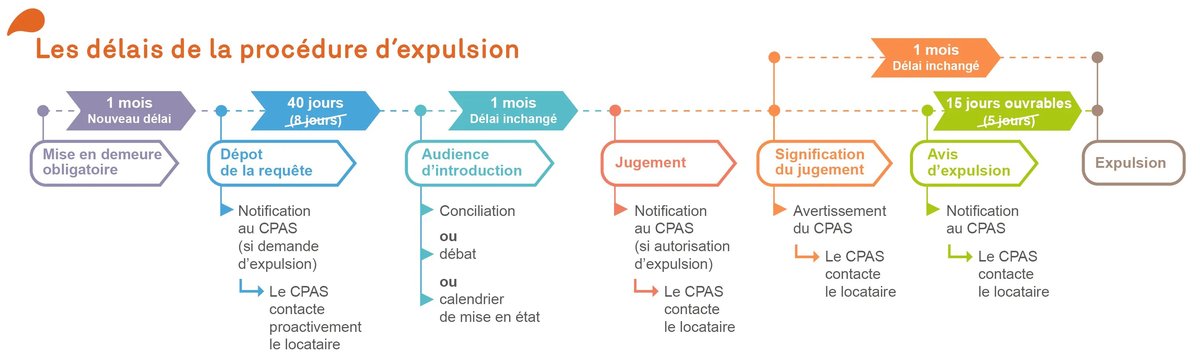
It's a scenario no landlord wants to face, yet for many property owners in France, it becomes an unavoidable reality: an unresponsive tenant, accumulating unpaid rent, and the daunting prospect of eviction. Navigating 'La Procédure Légale d'Expulsion: Étapes et Délais'—the legal eviction procedure, its steps, and timelines—can feel like entering a labyrinth without a map. But fear not; with a clear understanding of the process, you can approach this complex journey with confidence and clarity.
This isn't just a legal manual; it's your comprehensive guide, designed to cut through the jargon and equip you with the knowledge you need to protect your investment. We’ll break down every crucial step, demystify the timelines, and highlight the critical factors that can make or break your case.
At a Glance: What You Need to Know About French Eviction Law
- Strict Legal Process: Eviction in France is highly regulated, primarily by the law of July 6, 1989, and the Code of Civil Procedure. Owners cannot self-evict tenants.
- Heavy Penalties for Self-Eviction: Illegally evicting a tenant can lead to 3 years in prison and a 30,000€ fine.
- Long and Costly: The average procedure lasts 8 to 12 months (excluding the winter truce) and can cost owners 2,500€ to 4,000€ in fees, plus substantial unpaid rent.
- GLI Insurance is Key: Garantie Loyers Impayés (Unpaid Rent Guarantee) insurance is highly recommended, covering most unpaid rent and procedural costs.
- The 7 Mandatory Steps: From formal notice to physical eviction, there’s a precise sequence of actions involving bailiffs, courts, and public authorities.
- The Winter Truce: From November 1 to March 31, physical evictions are prohibited, but legal proceedings can continue. Strategic timing is crucial.
The Harsh Reality: Why French Eviction is a Marathon, Not a Sprint
Let's be blunt: recovering a property from a non-paying tenant in France is neither quick nor cheap. The legal framework is designed with significant protections for tenants, making the process lengthy and intricate. Forget any notions of simply changing locks or cutting utilities; these actions are not only illegal but also carry severe criminal penalties. As the law stands, a landlord attempting to self-evict a tenant risks up to 3 years in prison and a 30,000€ fine. This underscores the absolute necessity of adhering to the letter of the law.
The entire process, from the first missed payment to the eventual recovery of your property, typically spans 8 to 12 months. In busy judicial districts like Paris, this can stretch to 15-18 months, while less congested areas might see it completed in 6-7 months. Beyond the time commitment, the financial burden is significant, ranging from 2,500€ to 4,000€ in direct procedure fees. Add to that the accumulating unpaid rent, and your total loss could easily soar to 8,500€ to 16,000€. These figures highlight why preparedness and a clear strategy are paramount.
The Lifeline: Understanding GLI Insurance (Garantie Loyers Impayés)
Before diving into the procedural specifics, let's talk about your best defense: GLI insurance (Garantie Loyers Impayés). This unpaid rent guarantee is not just an option; it's a strategic imperative for landlords in France. For an annual cost of roughly 200-400€, GLI insurance typically covers:
- Unpaid rent and rental charges.
- Legal fees associated with the eviction procedure.
- Property damage caused by the tenant (often an add-on).
- Loss of rent during the period the property is vacant after the tenant has left, while repairs are being made.
As you'll see from our real-world example later, GLI can dramatically mitigate your financial exposure, transforming a potentially devastating loss into a manageable one. It’s an investment that pays for itself many times over if you ever find yourself facing an eviction.
Decoding 'La Procédure Légale d'Expulsion': The 7 Mandatory Steps
The French eviction process is meticulously defined by 7 mandatory steps. Each stage has its own legal requirements, associated costs, and typical delays. Missing a step or making an error can lead to significant setbacks, forcing you to restart parts of the procedure.
Step 1: Early Action & Amicable Formal Notice (Optional but Highly Recommended)
Time is of the essence when rent isn't paid. You should ideally act within 5-10 days of the first missed payment. While not legally mandatory, sending an amicable formal notice is a crucial first line of defense.
- When: After one month of unpaid rent.
- How: Send a registered letter with acknowledgment of receipt (Lettre Recommandée avec Accusé de Réception).
- Content: Clearly detail the exact sums due, set a strict 8-15 day deadline for regularization, explicitly warn of legal action if the deadline is missed, and mention the possibility of contacting the FSL (Fonds de Solidarité Logement - Housing Solidarity Fund) for assistance.
- Cost: Approximately 5-10€.
- Impact: This simple step resolves about 20% of cases, saving you months of further procedure and significant costs. It's an efficient way to prompt payment and demonstrate your serious intent.
Step 2: The Mandatory Command to Pay (Commandement de Payer)
If the amicable notice doesn't yield results, this is where the formal legal procedure truly begins. This step is mandatory.
- Who: A territorially competent bailiff (Huissier de Justice) signifies this legal act.
- What: The "Commandement de Payer" officially demands payment of all outstanding sums, including rent, charges, and late penalties. It also contains an express clause for the termination of the lease (clause résolutoire).
- Tenant's Deadline: The tenant is granted an incompressible 2-month period to regularize their situation. During this time, they can pay the arrears or request payment delays from a judge.
- Outcome: If payment is made, the procedure stops. If not, the lease is automatically terminated at the end of the 2 months by virtue of the "clause résolutoire."
- Cost: Typically 120-250€.
- Key Point: This document officially marks the beginning of the legal eviction procedure.
Step 3: Summons to Court for Lease Termination and Eviction (Assignation en Justice)
If the tenant fails to regularize their situation within the 2-month period of the "Commandement de Payer," you proceed to court.
- Who: A bailiff delivers a summons (Assignation) to the tenant.
- Where: The summons is filed with the judicial tribunal (Tribunal Judiciaire) of the dwelling's location.
- What it Requests: The summons asks the judge for:
- The formal termination of the lease.
- The eviction of the tenant (and any occupants).
- Condemnation of the tenant (and often their guarantor, if applicable) to pay all accumulated unpaid rent, charges, penalties, and legal costs.
- Provisional execution of the judgment, which allows the eviction process to continue even if the tenant appeals the decision.
- Cost: 300-500€.
- Timeline: The hearing typically takes place 2-4 months after the summons is delivered. This period allows time for the tenant to prepare their defense and for social services to potentially intervene.
Step 4: The Court Hearing and Judgment
This is where your case is formally presented and decided.
- The Hearing: Both parties (or their lawyers) present their arguments to the judge. The judge will consider all elements, including the tenant's financial situation, any efforts made to pay, and the validity of the landlord's claims.
- Outcome Statistics (2024):
- 78% of eviction requests were granted, leading to lease termination and an eviction order.
- 15% were granted additional delays for the tenant (3 to 12 months) due to specific circumstances (e.g., social difficulties, medical reasons).
- 7% were rejected due to procedural irregularities on the landlord's part or valid tenant defenses.
- Recommendation: Lawyer: While not mandatory, hiring a lawyer is highly recommended. Owners with legal assistance win approximately 85% of cases, compared to 65% for unassisted owners. A lawyer ensures all procedural steps are correctly followed and your case is presented effectively.
- Lawyer Cost: 800-1,500€.
- The Judgment: The judge's decision typically orders:
- Immediate lease termination.
- Eviction of the tenant, with the possibility of resorting to public force if necessary.
- Condemnation of the tenant and/or guarantor for all due sums.
- Provisional execution of the judgment.
- Judgment Timeline: The judgment is usually rendered 2-4 weeks after the hearing.
Step 5: Command to Vacate the Premises (Commandement de Quitter les Lieux)
Once you have a favorable judgment, the next step is to inform the tenant they must leave.
- Who: A bailiff signifies this command to the tenant.
- What it Orders: It officially informs the tenant that the lease is terminated and they must vacate the premises.
- Tenant's Deadline: The tenant is granted an incompressible 2-month period to voluntarily leave the property.
- Benefit: If the tenant leaves during this 2-month window, you avoid the significant cost and logistical complexity of a physical eviction (saving roughly 800€).
- Cost: 150-250€.
Step 6: Requisition of Public Force (Demande de Concours de la Force Publique)
If the tenant remains in the property after the 2-month period granted by the "Commandement de Quitter les Lieux," you must seek assistance from the state to enforce the eviction.
- Who: The bailiff requests assistance from the Prefect (Préfet), representing the police or gendarmerie.
- Prefect's Response: The Prefect has a 2-month period to respond to this request.
- Typical Outcome: In about 95% of cases, assistance is granted within 3-6 weeks.
- Rare Refusal: Refusals are rare but can occur due to procedural irregularities or if the property is located in specific "requisition zones" (though these are highly exceptional).
- Cost: This administrative step is free.
Step 7: The Physical Eviction (Expulsion Effective)
This is the final, often emotionally charged, step in the procedure, where the property is physically recovered.
- When: Once the Prefect grants the assistance of public force.
- Who Attends: The bailiff, accompanied by law enforcement (police or gendarmerie), a locksmith (to change locks), and potentially a moving company (to remove tenant belongings).
- Procedure: The bailiff drafts an eviction report (Procès-Verbal d'Expulsion) detailing the condition of the dwelling and an inventory of any furniture or personal items left behind.
- Tenant's Belongings: Left furniture is stored at the tenant's expense for a period of 2 months, after which it may be auctioned off to cover storage costs or discarded.
- Cost: 600-1,200€.
The Winter Truce (Trêve Hivernale): A Critical Factor
Understanding the Trêve Hivernale is crucial for any landlord in France. This "winter truce" is a legally mandated period during which physical evictions are prohibited.
- Dates: Annually, from November 1 to March 31.
- What it Prohibits: Physical expulsion from the dwelling cannot be carried out during these months, regardless of whether a judgment has been obtained.
- What it Allows: Crucially, all preliminary legal steps can still proceed during the winter truce. This includes:
- Issuing the "Commandement de Payer" (Step 2).
- Filing the "Assignation en Justice" (Step 3).
- Holding the court hearing and obtaining a judgment (Step 4).
- Signifying the "Commandement de Quitter les Lieux" (Step 5).
- Requesting public force (Step 6).
- Exceptions: Physical evictions during the truce are only permitted in very rare, exceptional cases, such as squatting or proven violence.
- Strategic Timing: For landlords, an optimal strategy is to initiate the procedure in January. This allows you to obtain a judgment and complete the "Commandement de Quitter les Lieux" by April or May, enabling the physical eviction to take place immediately after the truce ends on April 1st. This approach helps avoid an additional full year of delay.
Total Time and Cost: The Sobering Figures
Let's consolidate the timelines and costs so you can fully appreciate the commitment involved in 'La Procédure Légale d'Expulsion: Étapes et Délais'.
Typical Duration (without winter truce impact):
- Step 1 (Amicable Notice): 1 month (optional)
- Step 2 (Command to Pay): 2 months (incompressible)
- Step 3 (Summons to Court): 2-4 months for hearing
- Step 4 (Judgment): 2-4 weeks after hearing
- Step 5 (Command to Vacate): 2 months (incompressible)
- Step 6 (Public Force Requisition): 3-6 weeks (Prefect response)
- Step 7 (Physical Eviction): Immediately after public force approval
Total Estimated Duration: 8 to 12 months (excluding any winter truce delays). - In congested courts (e.g., Paris), this can extend to 15-18 months.
- In less busy provincial courts, it might be as short as 6-7 months.
Estimated Costs for the Owner (Procedure Fees Only): - Step 1: 5-10€
- Step 2: 120-250€
- Step 3: 300-500€
- Step 4 (Lawyer, highly recommended): 800-1,500€
- Step 5: 150-250€
- Step 6: Free
- Step 7: 600-1,200€
Total Procedure Fees: 2,500€ to 4,000€.
Total Financial Loss (including unpaid rent):
This is where the figures truly sting. Beyond the procedure fees, you're losing monthly rent. If the process takes 10 months and your rent is 650€/month, that's 6,500€ in unpaid rent. - Estimated Total Loss (Procedure Fees + Unpaid Rent): 8,500€ to 16,000€.
This significant financial exposure is precisely why GLI insurance is such a game-changer.
Real-World Impact: A Case Study (Mme Petit)
To illustrate the stark reality, let's look at a real-life example:
Mme Petit, a landlord, initiated an eviction procedure in March 2025 after her tenant accumulated 5 months of unpaid rent, totaling 3,250€.
- Duration: The entire process, from initial notice to physical eviction, took 10 months and 18 days.
- Procedure Costs: Mme Petit incurred 2,785€ in bailiff and legal fees.
- Unpaid Rent Accumulation: By the time the eviction was complete, the tenant had accumulated 14 months of unpaid rent, amounting to 9,100€.
- Total Loss: Mme Petit's total financial loss (fees + unpaid rent) was a staggering 11,885€.
However, Mme Petit had GLI insurance. - GLI Coverage: Her GLI policy covered 7,280€ of the unpaid rent and all her procedural costs.
- Actual Loss: This reduced her actual out-of-pocket loss to just 1,820€.
This example powerfully demonstrates the value of GLI insurance. Without it, Mme Petit would have faced a devastating financial blow.
Common Questions & Misconceptions About French Eviction
It’s easy to misunderstand parts of such a complex legal process. Here are some common questions and clarifications:
"Can I change the locks myself or cut off utilities?"
Absolutely not. As mentioned, this is illegal and carries severe penalties (3 years in prison, 30,000€ fine). You must follow the legal procedure.
"What if the tenant claims poverty or has young children?"
French law provides for social support and protective measures. The FSL (Housing Solidarity Fund) can assist tenants with rent arrears. Judges often grant additional delays (3-12 months) for vulnerable tenants, especially those with young children, if they can demonstrate genuine efforts or significant social difficulties, even if the lease is terminated. This is why the process can be so lengthy.
"Is a lawyer always necessary?"
While not legally mandatory for all steps, a lawyer is highly recommended. As our data shows, landlords with legal assistance have a significantly higher success rate (85% vs. 65%). A lawyer ensures procedural correctness, proper documentation, and effective representation, which can save time and money in the long run.
"What happens to the tenant's belongings after eviction?"
An inventory is taken, and the items are stored at the tenant's expense, typically for two months. If the tenant doesn't retrieve them or cover the costs, the items can be sold at public auction to recoup expenses or, if deemed worthless, disposed of.
"Can I refuse to renew a lease if I want to sell or move in myself?"
Yes, under specific conditions. You can serve a "congé pour vente" (notice to vacate for sale) or "congé pour reprise" (notice to vacate for personal use) at the end of the lease term, provided you follow strict notice periods (6 months for unfurnished, 3 months for furnished) and formal requirements. However, this is distinct from an eviction for unpaid rent. For a deeper dive into lease termination, you might find our complete Expulsée guide particularly helpful.
Navigating the Maze: Best Practices for Landlords
Given the complexities of 'La Procédure Légale d'Expulsion: Étapes et Délais', being proactive and well-informed is your best strategy.
- Thorough Tenant Screening: This is your first and most important line of defense. Robust financial checks, guarantor requirements, and reference verification are crucial.
- Invest in GLI Insurance: We cannot stress this enough. It’s the single most effective way to protect your income and cover legal costs.
- Act Early: As soon as rent is overdue, initiate communication. The amicable formal notice (Step 1) is a low-cost, high-impact tool.
- Maintain Meticulous Documentation: Keep precise records of all communications (emails, registered letters), rental payments, legal documents, and bailiff acts.
- Seek Legal Counsel Promptly: If the amicable phase fails, engage a lawyer or a bailiff immediately. Don't delay, as every day of delay means more unpaid rent and a longer procedure.
- Understand the Winter Truce: Strategically time your actions to avoid prolonged delays caused by the Tr��ve Hivernale.
- Stay Informed: Laws and regulations can change. Regularly consult reliable sources or legal professionals to stay updated.
Your Next Steps: Preparing for the Unforeseen
The prospect of an eviction can be daunting, but by understanding 'La Procédure Légale d'Expulsion: Étapes et Délais', you empower yourself. French law, while protective of tenants, provides clear mechanisms for landlords to recover their property and due payments. The key is adherence to the legal framework, patience, and strategic planning.
Don't wait for a crisis to understand your rights and obligations. Take the time now to:
- Review your current lease agreements.
- Investigate GLI insurance options if you don't already have a policy.
- Familiarize yourself with the local bailiffs and legal professionals in your area.
By taking these proactive steps, you transform uncertainty into preparation, ensuring that should you ever face an eviction scenario, you are ready to navigate it effectively and minimize its impact on your investment.